Blog

  • Your Quick-Start Guide to a Leadership Operating System: Do This First to Scale

    Your Quick-Start Guide to a Leadership Operating System: Do This First to Scale

    In the high-stakes environment of business growth, most organizations fail not because of a lack of vision, but due to a lack of a cohesive "engine" to drive that vision forward. As a company moves beyond its initial startup phase, the informal handshakes and "tribal knowledge" that once sufficed become liabilities. To scale effectively, you must transition from accidental leadership to an intentional Leadership Operating System (LOS).

    A Leadership Operating System is the intentional design of how you lead, manage, and scale your organization. It is the framework that ensures your mission is translated into measurable behavior change: creating a culture of accountability and high performance. At Legacy Vanguard Scott Group, we view this through the lens of military-grade discipline: translating the "Rhythm of Battle" into a sustainable "Operational Rhythm" for civilian success.

    If you are ready to stop putting out fires and start building a legacy, this is your quick-start guide to the foundational framework of a LOS.

    The Foundation: Commander’s Intent (Strategic Alignment)

    The most critical failure in scaling is the "dilution of intent." As an organization grows, the distance between the CEO’s vision and the front-line execution increases. To prevent this, you must master Commander’s Intent (Strategic Alignment).

    In military operations, Commander’s Intent is a clear, concise expression of the purpose of the operation and the desired end state. In the corporate world, this translates to Strategic Alignment: the non-negotiable definition of what "winning" looks like for your organization.

    Before you can scale, your leadership team must define:

    • The Mission: Why do we exist today?
    • The Vision: Where are we going in three to five years?
    • The End State: What does the landscape look like once we succeed?

    Without this clarity, your team will optimize for the wrong goals. Establishing Strategic Alignment ensures that even when communication breaks down, every team member understands the overarching objective and can exercise initiative to achieve it. This is the first step to elevating your leadership from micro-management to mission-driven oversight.

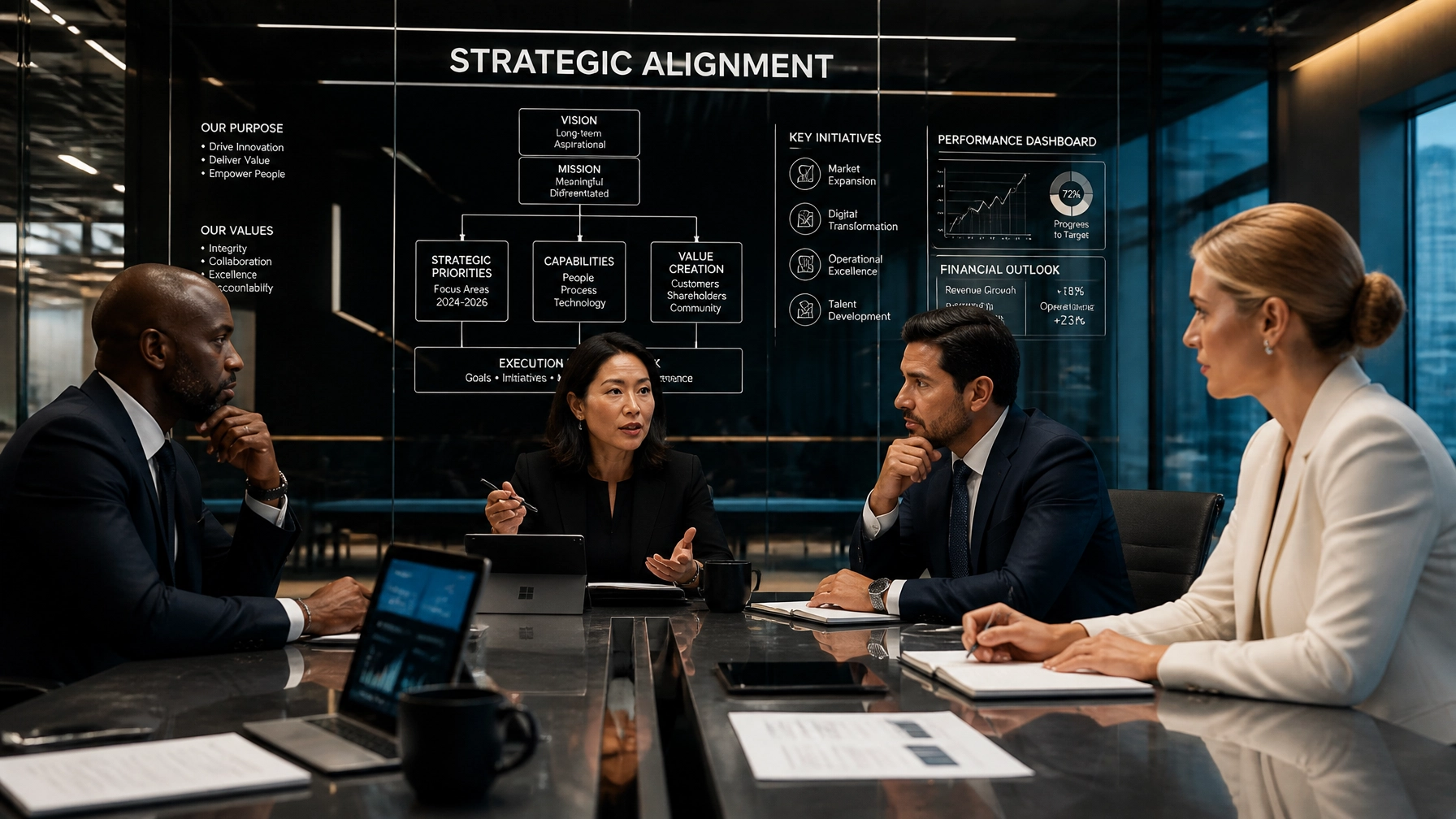
    Diverse executive leadership team collaborating on strategic alignment and mission-driven oversight.

    Phase 1: Establish the Battle Rhythm (Operational Cadence)

    Once the destination is clear, you need a heartbeat to keep the organization moving. In the military, this is known as the Battle Rhythm; in business, we call this the Operational Cadence.

    An Operational Cadence is a synchronized sequence of meetings, reports, and checkpoints that ensures information flows vertically and horizontally. Most businesses suffer from "meeting fatigue" because their meetings lack a specific purpose within an operating system. A true LOS utilizes a tiered approach to communication:

    1. The Daily Stand-up (Daily Huddle): A 15-minute high-impact session focused on immediate obstacles and the next 24 hours.
    2. The Weekly Sync (Operational Review): A focused look at the week’s Key Performance Indicators (KPIs) and resource allocation.
    3. The Monthly Deep-Dive (Strategic Review): A time to step back from the "tactical" and evaluate progress toward long-term milestones.
    4. The Quarterly Off-site (Strategic Pivot): A formal session to realign the Commander’s Intent with market realities.

    By hardening this cadence, you eliminate the need for "urgent" ad-hoc meetings that disrupt deep work. This structure creates a predictable environment where leadership can empower their teams to perform without constant supervision.

    Phase 2: Standardizing the Response (SOPs and Decision Rights)

    Scalability is impossible if the founder or CEO is the only person authorized to make a decision. To scale, you must distribute power. This requires two things: Standard Operating Procedures (SOPs) and clearly defined Decision Rights.

    In tactical environments, "SOPs" are life-saving protocols. In business, they are the "Manual of Arms" for your corporate operations. SOPs ensure that "The Legacy Vanguard Scott Group way" is executed with consistency, regardless of who is in the seat.

    However, SOPs are only half the battle. You must also define Decision Rights (Authority Matrices). You must explicitly state who has the authority to spend money, hire talent, and change processes. By codifying these rights, you remove bottlenecks and ignite a sense of ownership across your leadership pipeline. When people know exactly where their authority begins and ends, they move faster and with more confidence.

    Professional team participating in a daily huddle to review performance metrics and operational cadence.

    Phase 3: The After Action Review (Strategic Debrief)

    A Leadership Operating System is not a static document; it is a living entity that must be refined through constant feedback. The most powerful tool for this is the After Action Review (Strategic Debrief).

    An AAR is a professional discussion of an event, focused on performance standards, that allows a team to discover for themselves what happened, why it happened, and how to sustain strengths and improve on weaknesses. To implement this as a "quick win" in your LOS, follow this four-question framework after every major project or milestone:

    1. What was supposed to happen? (Review the original Strategic Alignment)
    2. What actually happened? (Identify the ground truth)
    3. Why did it happen? (Root cause analysis: focus on the "what," not the "who")
    4. What will we do differently next time? (Concrete action items for behavior change)

    Integrating the Strategic Debrief into your culture transforms failures into tuition. It removes the fear of blame and replaces it with a relentless pursuit of excellence. This commitment to continuous improvement is what separates "good" companies from those building a lasting legacy.

    Phase 4: Strengthening the Pipeline (Strategic Recruiting)

    Your Leadership Operating System is only as strong as the people who operate it. As you begin to scale, you will quickly realize that the team that got you to $1M may not be the team that gets you to $10M. This is where Strategic Recruiting and Placement becomes a core component of your LOS.

    You must view recruiting not as a "reactive" HR function, but as a "proactive" leadership function. This involves:

    • Culture Alignment: Identifying candidates who share your mission-driven mindset.
    • Capability Assessment: Ensuring new hires have the technical discipline to operate within your system.
    • Leadership Development: Training your current managers to become the next generation of executives through personalized 1:1 coaching.

    A veteran-led approach to HR focuses on "Force Multipliers": individuals whose presence makes everyone around them better. By integrating a strategic recruiting solution into your LOS, you ensure that your growth is supported by top-tier talent that is already aligned with your operating principles.

    Executive shaking hands with top-tier talent to represent strategic recruiting and organizational culture alignment.

    Execution: Do This First

    If you are overwhelmed by the prospect of building a full LOS, start with one thing: The Operational Rhythm.

    Establish your weekly sync. Make it non-negotiable. Use that time to define your Commander’s Intent for the month. Once that rhythm is established, the other pieces: the SOPs, the AARs, and the Decision Rights: will naturally fall into place because the system demands them.

    Scaling a business requires more than just "working harder." it requires the discipline to build a system that can work without you. It requires a commitment to high standards, absolute accountability, and a mission-driven culture.

    Building a Leadership Operating System is the ultimate act of leadership. It is how you transition from being a "boss" to becoming a builder of a legacy. This is not a quick fix: it is a hardening of your corporate DNA to ensure long-term success and breakthrough performance.

    Are you ready to move from chaos to clarity? The framework is ready. The discipline is required. Let’s get to work.

    Who’s ready to harden their culture and build a legacy? 🔥 🌐 https://www.legacyvanguardscott.com/ 🌐

  • Do You Really Need a Leadership Operating System? Here’s the Truth About High-Performance Teams

    Do You Really Need a Leadership Operating System? Here’s the Truth About High-Performance Teams

    In the high-stakes world of executive leadership, "performance" is often treated as a nebulous quality: something you either have or you don't. Leaders spend millions on talent acquisition and "culture building" without ever addressing the underlying architecture that governs how their people actually work.

    At Legacy Vanguard Scott Group (LVSG), we view leadership through a different lens. As a veteran-owned firm, we understand that high performance isn't a personality trait; it is the output of a disciplined system. We call this the Leadership Operating System (Leader OS).

    If your organization is currently grappling with persistent vacancies, stagnant growth, or a culture of "firefighting," the problem isn't your people. It’s your operating system: or the lack thereof.

    The "Supervision Tax": The Hidden Cost of Chaos

    Before we define the solution, we must identify the parasite. In many organizations, there is a hidden "Supervision Tax": a persistent drain on resources caused by the need for constant, manual oversight.

    The Supervision Tax manifests as:

    • Decision Bottlenecks: Leaders who are required to approve every minor action because their "Commander's Intent" (Strategic Alignment) was never clearly communicated.
    • Redundant Meetings: Hours spent "getting on the same page" because the "Rhythm of Battle" (Operational Rhythm) is nonexistent.
    • Talent Attrition: Top-tier performers leaving because they are micromanaged by leaders who lack a structured framework for delegation.

    When you lack a Leadership Operating System, your leaders are forced to spend 80% of their time supervising "the how" rather than strategizing "the why." This inefficiency is a direct hit to your bottom line and a barrier to building a lasting legacy.

    An illustration of 'The Invisible Drain' showing a cluttered, chaotic business dashboard transforming into a clear, streamlined digital interface representing the reduction of the Supervision Tax

    What Exactly is a Leadership Operating System?

    A Leadership Operating System is a repeatable framework that standardizes how leadership happens within an organization. It is the "software" that runs on your human "hardware." It answers the critical questions that often go unasked:

    1. How do we set and communicate direction?
    2. How do we run meetings that actually drive results?
    3. How do we make decisions at speed?
    4. How do we hold individuals accountable without micromanaging?

    Without a standardized OS, every manager leads differently. This inconsistency creates friction, confusion, and eventually, a breakdown in organizational stability. By implementing a customized LOS, you transition from person-dependent performance to system-dependent performance.

    Mission Command: The DNA of High-Performance Teams

    At LVSG, we lean heavily on the military principle of Mission Command (Strategic Empowerment & Intent-Based Leadership).

    In a combat environment, a commander cannot be everywhere at once. Success depends on the ability of every individual to exercise "Disciplined Initiative" (Autonomous Problem-Solving) based on a clear understanding of the "Commander’s Intent" (Strategic Alignment).

    Civilian Translation Layer:

    • Commander’s IntentStrategic Alignment: A clear statement of the "why" and the "what" that allows teams to decide the "how" independently.
    • AAR (After Action Review)Strategic Debrief: A structured process for analyzing what happened, why it happened, and how to improve.
    • Rhythm of BattleOperational Rhythm: The predictable cadence of meetings, reports, and checkpoints that keeps the organization moving.

    When you apply Mission Command (Strategic Empowerment) to a corporate setting, you empower your mid-level managers to lead with confidence. You give them the guardrails they need to take "Prudent Risk" (Calculated Business Decisions) without waiting for a green light from the C-suite.

    A diverse team of professionals: including a Black woman leader and an Asian man: moving confidently toward a clear objective in a modern corporate setting

    The Core Components of an Elite Leadership OS

    To harden your culture and elevate performance, your Leadership OS must be built on four foundational pillars:

    1. Strategic Alignment (Commander’s Intent)

    High-performance teams do not wait for instructions. They move toward an objective because the leader has clearly defined the desired end state. In our Executive Leadership Coaching, we teach leaders how to articulate a vision so clearly that their presence is no longer required for the team to execute.

    2. Operational Rhythm (Rhythm of Battle)

    Chaos thrives in the absence of structure. An elite OS establishes a "cadence of accountability." This isn't about more meetings; it's about the right meetings. Weekly huddles focus on blockers and "Strategic Debriefs" (AARs) focus on learning from failures and successes alike. This rhythm creates momentum and ensures that no one is "drifting" off-course.

    3. Decision Rights & Guardrails

    One of the primary causes of the "Supervision Tax" is unclear decision rights. Your OS must explicitly define who has the authority to make specific calls. By establishing clear guardrails: policy, ethics, and service standards: you give your team the freedom to act within those boundaries.

    4. Measurable Behavior Change

    A Leadership OS isn't just a document; it’s an "Operating System for Behavior." We use data-driven insights and auditable staffing engines to ensure that the leadership habits being formed are leading to tangible outcomes: reduced vacancies, higher retention, and improved service quality.

    A modular diagram-style image showing blocks labeled Alignment, Rhythm, Trust, and Results being assembled by a diverse group of hands

    The LVSG Difference: Linking Leadership to Staffing

    Most consulting firms offer either "soft" leadership coaching or "hard" recruitment services. Legacy Vanguard Scott Group is different. We recognize that these two functions are inextricably linked.

    If you have a broken Leadership Operating System, your "Strategic Recruiting" (Talent Acquisition) efforts will fail. You will hire top talent only to watch them wither in a culture of micromanagement or leave due to a lack of clarity.

    Our dual-service model: linking coaching with a structured, auditable staffing engine: ensures that your new hires are being onboarded into a high-performance environment designed for their success. We don't just fill seats; we harden the culture so those seats stay filled.

    The Path to Legacy

    Choosing to implement a Leadership Operating System is an act of discipline. It requires a shift from "leading by feeling" to "leading by design." It is the difference between a company that survives and an organization that leaves a legacy.

    Whether you are a veteran-owned small business or a large public-sector employer, the truth remains the same: your success is limited by the quality of your operating system.

    We’re also building something new behind the scenes: our Leadership OS Ebook series, launching in June. Stay tuned as we deep-dive into the systems, structures, and leadership habits that help organizations strengthen culture, sharpen execution, and create lasting impact.

    Are you ready to stop paying the "Supervision Tax"? Are you ready to empower your team to lead with the precision of a high-performance military unit?

    Who’s ready to harden their culture and build a legacy? 🔥 🌐 https://www.legacyvanguardscott.com/ 🌐

    A diverse executive team: a Hispanic man, a Black woman, and an Asian woman: looking out at a city skyline from a high-rise office, representing long-term success and legacy


  • The Leadership Hardening Debrief: Week 1 Recap & Your Next Mission

    The Leadership Hardening Debrief: Week 1 Recap & Your Next Mission

    Maintaining the high ground in today’s volatile market requires more than just "checking the boxes." It requires a standard of excellence that is relentlessly enforced. This week, Legacy Vanguard Scott Group (LVSG) launched the Leadership Hardening initiative: a tactical approach to organizational health designed to move your firm from surviving to thriving.

    As we conclude this initial phase, it is time for an AAR (After Action Review: or Strategic Debrief). We have spent the last few days identifying the fractures in your current organizational structure, auditing the efficiency of your hiring engine, and exposing the hidden financial drains that occur when leadership is spread too thin.

    If you missed any part of this mission, consider this your Sitrep (Situation Report: or Status Update). Here is the intelligence you need to harden your culture and secure your legacy.


    Phase 1: The Diagnostic – Identifying the Fractures

    A Hispanic female executive analyzing red flags on a digital dashboard.

    Every failure in an organization can be traced back to a failure in leadership. On Monday, we focused on the diagnostic phase: identifying the silent killers of culture. When the Commander’s Intent (Strategic Alignment) is lost, the mission fails by default.

    We identified the 7 Red Flags You're Losing Control of Your Leadership Culture. These warning signs: ranging from "The Silent Treatment" in meetings to the "Revolving Door" of talent: indicate that your organizational integrity is compromised. Leaders who ignore these signals are essentially allowing their Rhythm of Battle (Operational Rhythm) to be dictated by chaos rather than strategy.

    Key Insight: Culture isn't what you say in a handbook; it is the behavior you tolerate. If you aren't actively hardening your culture, it is softening by neglect.


    Phase 2: Operational Cleanup – Fixing the Hiring Engine

    Diverse leaders collaborating in a high-energy HR environment focused on strategic recruiting.

    Once the internal fractures are identified, the next step is to ensure you have the right personnel to execute the mission. Tuesday was dedicated to the Operational Cleanup of your HR and staffing strategies.

    Small and mid-size businesses often fall into the trap of "panic hiring": filling a vacancy with the first available person rather than the right person. This lack of Strategic Recruiting leads to a mismatch in values and skills, ultimately poisoning the team’s morale and productivity.

    We broke down the 7 Mistakes You're Making with HR Staffing, highlighting why "gut feelings" are no substitute for an auditable, data-driven staffing engine. To protect your service quality, you must treat hiring as a mission-critical operation, not an administrative burden.

    Key Insight: A bad hire is more expensive than a vacancy. Stop compromising your standards for the sake of speed.


    Phase 3: The Financial Drain – Killing the Supervision Tax

    A digital clock leaking currency symbols, representing the Supervision Tax and lost productivity.

    On Wednesday, we attacked the most insidious cost in your business: The Supervision Tax. This is the measurable loss of productivity and profit that occurs when high-level leaders are forced to micro-manage underperforming staff or fill the gaps left by "Ghost Vacancies."

    In healthcare and growth-stage firms, this tax is lethal. When your executives are busy doing the work of their subordinates, they are not leading: they are merely reacting. This creates a cycle where Decision Rights are muddied and the Operational Rhythm is shattered.

    We provided 5 specific steps to eliminate this drain, emphasizing that your leaders' time should be spent on strategic growth, not tactical firefighting. By hardening your supervision standards, you reclaim your most valuable asset: time.

    Key Insight: You are paying a premium for leadership. If your leaders are spending 40% of their time supervising poor behavior, you are effectively burning 40% of your executive payroll.


    Phase 4: The Path Forward – The Leadership Operating System (L-OS)

    A sleek 3D diagram representing a Leadership Operating System with icons for strategy and growth.

    Identifying problems and cleaning up errors is only the beginning. To achieve Breakthrough Performance, your organization needs a sustainable framework: a "Leadership Operating System."

    This coming Friday, we are unveiling the Apex: The Leadership Operating System. This is the culmination of our dual-service model, linking executive coaching with a structured staffing engine. It moves beyond "HR advice" and into the realm of Strategic Alignment, ensuring that every person in your organization understands their role, their value, and the mission at hand.

    The L-OS is designed to ignite growth by establishing:

    • Clear Meeting Cadence: No more aimless gatherings; every interaction has a purpose.
    • Measurable Behavior Change: Moving beyond theory into tangible, auditable results.
    • Culture-Aligned Outcomes: Ensuring your growth doesn't come at the cost of your legacy.

    Key Insight: A business without an operating system is just a collection of people working in the same direction. A business with a Leadership OS is a disciplined force focused on a singular objective.


    Your Next Mission: Harden Your Leadership

    The intelligence we’ve shared this week is only as valuable as your willingness to act upon it. Knowing you have "Red Flags" is useless if you don't have the discipline to fix them. Acknowledging the "Supervision Tax" means nothing if you don't tighten your Decision Rights.

    Legacy Vanguard Scott Group is here to provide the veteran-led rigor and executive-level clarity your organization deserves. We don't just advise; we partner with you to build a firm that is resilient, disciplined, and destined for long-term success.

    Are you ready to move from diagnostic to execution?

    Who’s ready to harden their culture and build a legacy? 🔥 🌐 https://www.legacyvanguardscott.com/ 🌐

  • Executive Leadership Development Programs vs. Traditional Workshops: Which Is Better for Your Bottom Line?

    Executive Leadership Development Programs vs. Traditional Workshops: Which Is Better for Your Bottom Line?

    In the high-stakes environments of healthcare, public sector administration, and growth-stage enterprises, leadership is not a luxury: it is the primary operating system that dictates the success or failure of the entire mission. Yet, many organizations continue to treat leadership development as a "check-the-box" administrative task rather than a strategic investment.

    When faced with persistent vacancies, declining morale, or stagnating growth, executives often reach for the most convenient tool: the traditional one-day workshop. It’s quick, it’s relatively inexpensive, and it provides an immediate sense of "doing something." But does it actually move the needle? Does it harden your culture against the friction of the marketplace?

    For the serious leader focused on long-term legacy, the choice between a one-off workshop and a comprehensive Executive Leadership Development Program (ELDP) isn't just about training: it's about the financial health and operational integrity of the organization.

    The Illusion of the One-Day Workshop: Why "Inspiration" Isn't "Impact"

    Traditional workshops are the fast food of professional development. They are high in "flavor": engaging speakers, glossy workbooks, and a temporary surge in motivation: but low in long-term nutritional value for the organization.

    Research consistently shows that while these events can introduce new concepts, they rarely lead to measurable behavior change. Without follow-through, the "shelf life" of a workshop is remarkably short. Within weeks, participants often revert to old habits, and the "Strategic Alignment" (Commander’s Intent) discussed in the classroom evaporates under the pressure of daily operations.

    For a veteran-owned firm like Legacy Vanguard Scott Group, we understand that discipline is built through repetition and refinement, not a single PowerPoint presentation. If your leadership development strategy relies on occasional "lunch and learns," you aren't building a legacy; you're just paying for a temporary mood boost.

    The Hidden Drain: Understanding the "Supervision Tax"

    One of the most significant, yet frequently ignored, costs in any organization is what we call the Supervision Tax.

    The Supervision Tax is the cumulative cost of lost productivity, turnover, and error correction that stems directly from ineffective leadership. It is the price you pay when:

    • Managers micromanage because they lack trust in their team’s Strategic Execution (Mission Command).
    • Executives spend 60% of their time "firefighting" instead of driving long-term growth.
    • Persistent vacancies occur because the culture is too "soft" to retain top-tier talent.

    Traditional workshops fail to address the Supervision Tax because they don’t change the underlying Operating System of the leader. A comprehensive development program, however, is designed to harden the leadership structure. By improving leader behavior at the source, you reduce the need for constant oversight, effectively lowering your organization's "tax" and freeing up capital: both financial and cognitive: for strategic expansion.

    A professional 1:1 executive coaching session between an Asian man and a Hispanic woman, highlighting the personalized approach required for deep behavioral change.

    Building the "Apex" Leader: The Long-Term Program Advantage

    At Legacy Vanguard Scott Group, we prioritize Apex results. This requires a tiered, modular approach to development that mirrors the rigor of military discipline while remaining grounded in private-sector realities.

    Comprehensive programs: such as those offered in our leadership development consulting: focus on three critical pillars that workshops simply cannot touch:

    1. Personalized 1:1 Coaching

    True transformation is rarely a group activity. It requires a mirror: a "Strategic Debrief" (AAR): held up to an individual’s specific blind spots and strengths. Long-term programs integrate personalized 1:1 coaching to ensure that the concepts learned in a group setting are actually applied to the leader’s specific organizational challenges.

    2. Operational Rhythm (Rhythm of Battle)

    Success is a byproduct of your "Operational Rhythm" (Rhythm of Battle). This is the disciplined cadence of meetings, reporting, and decision-making that keeps an organization moving forward. A workshop might explain the concept, but a multi-month program actually embeds this rhythm into the leader’s daily routine until it becomes second nature.

    3. Decision Rights and Accountability

    One-off workshops often leave leaders with a list of "to-dos" but no clear authority or framework for execution. An integrated program defines "Decision Rights": the clear boundaries of who can make which choices: and pairs them with rigorous accountability measures. This is how you transition from a culture of "permission-seeking" to one of "Strategic Alignment" (Commander’s Intent).

    A diverse healthcare leadership team conducting a disciplined 'Operational Rhythm' (Rhythm of Battle) meeting in a hospital administrative hub.

    Mission Command: Strategic Alignment in the Boardroom

    In the military, "Mission Command" is the practice of empowering subordinates to exercise disciplined initiative within the "Commander’s Intent" (Strategic Alignment). In the civilian world, we call this Decentralized Leadership.

    It is the highest form of leadership efficiency. When your team understands the "why" (the intent) and the "how" (the operating system), they can navigate complex challenges without waiting for a direct order. This is particularly vital in healthcare and the public sector, where delays in decision-making can have catastrophic consequences.

    Workshops teach the theory of decentralized leadership. Legacy Vanguard Scott Group builds the reality of it. We help you move beyond simple "supervision" and into a state where your leaders are empowered to achieve breakthrough performance autonomously. This shift is what ultimately protects service quality and slashes the costs associated with lost productivity.

    Measuring the Apex: ROI and Behavioral Change

    The ultimate question for any executive is: What is the return on investment?

    With a traditional workshop, ROI is nearly impossible to track. You might look at "smile sheets" (participant satisfaction surveys), but those don't reflect the bottom line.

    With an Executive Leadership Development Program, ROI is measured through Tangible Behavioral Change. We look for:

    • Reduced Turnover: High-performing cultures attract and retain "A-players."
    • Improved Recruitment: A hardened culture becomes a magnet for talent, reducing your reliance on expensive, external staffing engines.
    • Operational Efficiency: Shorter meeting times, faster decision cycles, and fewer errors.
    • Strategic Growth: Leaders who have more time to focus on the mission because they aren't bogged down by the "Supervision Tax."

    A diverse group of professionals gathering for a 'Strategic Debrief' (AAR), analyzing data visualizations and charts to drive accountability and high standards.

    Choosing Impact Over Convenience

    If you are looking for a quick fix, a workshop is your answer. It is the easy path, the comfortable path, and ultimately, the path that leads to stagnation.

    However, if you are looking to ignite change, elevate your standards, and strengthen the very foundation of your organization, you must look toward structured, multi-component development. You must be willing to invest in an "Operating System" that survives long after the initial training ends.

    At Legacy Vanguard Scott Group, we are not just consultants; we are mission-driven advisors dedicated to your long-term success. We don’t just teach leadership: we harden it. We don’t just fill vacancies: we build the leadership engine that prevents them from occurring in the first place.

    An abstract, conceptual image representing 'Legacy' and long-term business growth with golden gears leading toward a bright, aspirational horizon.

    The choice is yours: a one-day distraction or a lifetime of impact. Which one will be your legacy?

    Who’s ready to harden their culture and build a legacy? 🔥 🌐 https://www.legacyvanguardscott.com/ 🌐

  • 10 Reasons Your Leadership Pipeline is Leaking (And How Strategic Recruiting Solutions Fix It)

    10 Reasons Your Leadership Pipeline is Leaking (And How Strategic Recruiting Solutions Fix It)

    In the high-stakes environment of healthcare and the rapid-fire expansion of growth-stage employers, leadership isn't just a title: it is the vital infrastructure of the organization. Yet, many organizations find themselves facing a critical "brownout" of talent. You have high-performers, you have open roles, and yet, the bridge between the two is collapsing.

    When your leadership pipeline leaks, you lose more than just productivity; you lose the "Commander’s Intent (Strategic Alignment)" that keeps your mission on track. A leaking pipeline leads to executive burnout, high turnover at the mid-management level, and an organizational culture that feels stagnant rather than empowered.

    To build a legacy, you must first diagnose the breach. Here are the 10 most common reasons your leadership pipeline is failing: and how a strategic approach to recruiting and development can harden your defenses.

    1. The "High-Performer Trap"

    The most common mistake in growth-stage companies is promoting based on technical proficiency rather than leadership potential. Being a world-class clinician or a top-tier software engineer does not automatically translate into the ability to lead a multidisciplinary team.

    When you promote someone solely for their output, you often lose a great "Individual Contributor" and gain a mediocre manager. Strategic recruiting solutions fix this by utilizing objective assessments that measure learning agility and emotional intelligence: ensuring the "high-potential" actually has the capacity to lead.

    2. Lack of a "Rhythm of Battle (Operational Rhythm)"

    Leadership development cannot be a sporadic event; it must be part of your organizational DNA. Many pipelines leak because there is no consistent "Rhythm of Battle (Operational Rhythm)" for mentorship or training. Without a structured cadence: weekly 1:1s, monthly leadership modules, and quarterly "AARs (After-Action Reviews / Strategic Debriefs)": potential leaders lose momentum and look for growth elsewhere.

    Diverse executive team collaborating on a digital strategy board to maintain operational rhythm.

    3. Failure to Transition: From Doing to Directing

    New leaders often struggle with the "Mindset Shift" required to move up the chain of command. They continue to operate as they did in their previous roles: micromanaging tasks instead of delegating outcomes. This creates a bottleneck. If your new leaders are still "in the weeds," they aren't scanning the horizon.

    Through custom-tailored management coaching, we help these individuals understand their new "Decision Rights" and how to empower their teams to execute without constant supervision.

    4. A Deficit in Psychological Safety

    In healthcare especially, the cost of a mistake can be life-altering. If your culture punishes "honest failures" or shuts down dissenting voices, your pipeline will dry up. High-potential talent will not step into leadership roles if they feel the risk to their reputation or career is too high.

    Building a legacy requires a culture where trust is the baseline. When psychological safety is high, leaders are willing to take the calculated risks necessary for breakthrough performance.

    5. Middle Managers as Blockers, Not Builders

    Your middle management layer is either a bridge or a wall. Sometimes, managers "hoard" talent because they don't want to lose their best producers to another department. This "talent silos" mentality kills the pipeline.

    Strategic recruiting isn't just about external hires; it's about internal mobility. We implement systems that reward managers for developing their successors, turning them into "Talent Builders" who take pride in seeing their direct reports ascend.

    6. The "Opt-Out" Trend

    We are seeing a rise in high-potential employees choosing to "opt-out" of the management track. The reason? They see the current leaders are stressed, overworked, and disconnected from the organization's purpose.

    To fix this, the leadership role itself must be "re-recruited." You must demonstrate that leadership at your organization is an opportunity to ignite change and build a lasting impact, not just a recipe for burnout.

    Healthcare executive viewing a city skyline, representing strategic alignment and leadership vision.

    7. Lack of "Commander’s Intent (Strategic Alignment)"

    If your team doesn't know where the ship is headed, they won't know why they should want to be on the bridge. A pipeline leaks when there is a disconnect between high-level strategy and day-to-day operations.

    When you clearly communicate the "Commander’s Intent (Strategic Alignment)," you give aspiring leaders a sense of purpose. They see how their growth contributes to the mission, which increases retention and engagement.

    8. Selection Bias and the "Mirror Effect"

    Many executives unconsciously select successors who look, think, and act exactly like them. While this feels comfortable, it creates a homogeneous leadership team that is vulnerable to groupthink. In growth-stage companies, you need a diverse array of perspectives to navigate new markets and challenges.

    Strategic recruiting solutions introduce "Blinded Assessments" and standardized criteria to ensure you are hiring for "Culture-Add" rather than just "Culture-Fit."

    9. Preparing for Yesterday’s War

    Traditional leadership programs often train people for the challenges the company faced three years ago. In a fast-moving healthcare or tech environment, that is a death sentence. Your pipeline must be forward-looking.

    You need a "Leadership Operating System" that is agile. This means developing leaders who are comfortable with ambiguity and who are trained in "Strategic Decision-Making" for future market conditions, not just historical ones.

    10. Disconnected Recruiting and Onboarding

    The final leak often happens at the very beginning. If your HR department is recruiting for "skills" while your Operations team is looking for "will," you will have a mismatch from Day 1.

    A strategic recruiting solution aligns these two functions. It ensures that every new hire is vetted not just for what they can do today, but for their potential to lead tomorrow.

    A professional candidate undergoing a rigorous leadership assessment for strategic recruiting solutions.

    How Strategic Recruiting Solutions Seal the Leaks

    At Legacy Vanguard Scott Group, we don't believe in quick fixes. We believe in strengthening the core of your organization through disciplined, veteran-led strategies. To stop the leaks, you must move beyond "staffing" and into "Strategic Talent Acquisition."

    The Apex Strategy for Pipeline Security

    1. Define the Standard: We help you establish a clear "Competency Framework" that defines what leadership looks like at every level: from the frontline to the C-suite.
    2. Identify the Gaps: Through rigorous "Gap Analysis," we identify where your pipeline is most vulnerable. Is it at the mid-management level? Is it a lack of diverse candidates?
    3. Harden the Selection Process: We implement "Mission-Aligned" recruiting. This means every external hire and internal promotion is subjected to a tiered evaluation process that mirrors the rigor of military selection.
    4. Continuous Development: Leadership is a perishable skill. We provide the "Executive Coaching" and "Management Training" necessary to ensure your leaders stay sharp and effective.

    The goal is to create a "Leadership Reservoir": a pool of talent that is so deep and so well-prepared that even unexpected departures or rapid growth won't stall your momentum.

    Build Your Legacy Today

    A leaking leadership pipeline is a quiet crisis. It doesn't always show up on the balance sheet immediately, but it eventually manifests as missed targets, cultural erosion, and lost market share.

    For healthcare organizations and growth-stage employers, the time to act is now. You have the vision; we have the framework to ensure you have the leaders to execute it. Whether you need to overhaul your recruiting process or implement a new Leadership Operating System, we are here to ensure your organization achieves breakthrough performance.

    Who’s ready to harden their culture and build a legacy? 🔥 🌐 https://www.legacyvanguardscott.com/ 🌐

  • The Ultimate Guide to Improving Organizational Culture: Everything You Need to Retain Your Top Talent

    The Ultimate Guide to Improving Organizational Culture: Everything You Need to Retain Your Top Talent

    For high-performing executives and organizational leaders, "culture" is often dismissed as a soft metric: a collection of HR buzzwords and office perks. This is a critical strategic error. At Legacy Vanguard Scott Group, we view organizational culture not as a secondary benefit, but as your company’s Leadership Operating System. It is the invisible infrastructure that determines how decisions are made, how stress is managed, and, ultimately, whether your top-tier talent stays to build a legacy or exits for a competitor.

    To retain the "A-Players" in your organization, you must move beyond superficial engagement and toward a culture of high accountability and mission-driven discipline. This guide outlines the framework for hardening your culture and transforming it into a retention engine that fuels long-term success.

    Commander’s Intent: The Power of Strategic Alignment

    In military operations, Commander’s Intent (Strategic Alignment) is the clear, concise expression of the purpose of the operation and the desired end state. In the corporate world, this translates to an absolute clarity of mission that transcends the quarterly earnings report.

    Top talent does not leave simply because of salary; they leave when they feel the mission is muddled or when leadership fails to articulate a "Why" that justifies their "How." Improving culture starts with establishing a unified direction that allows for Decentralized Command (Empowered Decision Rights). When your executives and managers understand the end goal, they can act with autonomy and precision.

    Diverse executive team establishing strategic alignment to improve organizational culture and decision rights.

    Steps to Achieve Strategic Alignment:

    • Define the Non-Negotiables: Identify the three to five core values that represent the "Line in the Sand." These are not aspirational; they are the behavioral standards required for every member of the team.
    • Communicate with Redundancy: Use multiple channels to reinforce the mission. If your team cannot recite the primary objective of the current quarter, you have a communication failure that creates organizational friction.
    • Audit for Misalignment: Regularly review your internal processes. If your stated goal is innovation, but your "Decision Rights" are bottlenecked at the top, you are creating a culture of stagnation that will drive high-performers out the door.

    Building a High-Accountability Environment

    Accountability is the bedrock of trust. In low-performance cultures, accountability is viewed as a "gotcha" tactic. In an Apex-level culture, accountability is viewed as a professional courtesy. It ensures that every team member can rely on the person to their left and right to execute their duties to the highest standard.

    To improve retention, you must eliminate the "cultural tax" paid by your top performers when they are forced to pick up the slack for underperformers. This requires a shift toward Extreme Ownership: the principle that every leader is responsible for everything in their world.

    Leaders in a strategic debrief promoting extreme ownership and high accountability within the organization.

    The Framework for High Accountability:

    1. Clear Standards of Performance: Document exactly what "success" looks like for every role. Vague expectations lead to subjective evaluations, which breed resentment.
    2. Radical Candor in Feedback: Implement a regular AAR (Strategic Debrief) process. After every major project or milestone, conduct a formal review of what went right, what went wrong, and how the process can be improved. This removes the "ego" from the equation and focuses on the mission.
    3. Consequences for Complacency: You get the behavior you tolerate. If you allow toxic high-performers or lazy "B-Players" to remain in the organization, you are effectively telling your top talent that your standards are a suggestion, not a requirement.

    The Rhythm of Battle: Establishing Operational Rhythm

    Organizational lethargy is a silent killer of culture. When communication is sporadic and meetings are purposeless, the "Operating System" begins to lag. To maintain momentum and keep your talent engaged, you must establish a disciplined Rhythm of Battle (Operational Rhythm).

    This is the cadence of meetings, reporting, and synchronization that keeps the organization moving forward. A disciplined rhythm reduces the "Fog of War" (Organizational Uncertainty) and ensures that everyone is operating with the most current data.

    Team members conducting a synchronized huddle to optimize operational rhythm and reduce organizational uncertainty.

    Elements of an Effective Operational Rhythm:

    • Daily Stand-ups (Synchronized Huddles): 15-minute high-impact briefings to identify "Blockers" and align daily tasks.
    • Weekly Strategic Reviews: Focused sessions to track progress against KPIs and adjust tactics in real-time.
    • Quarterly Off-sites: Deep-dive sessions to reset the "Commander’s Intent" and ensure long-term goals are still relevant in a shifting market.

    For organizations looking to refine these structures, our Capabilities Statement outlines how we integrate these military-grade frameworks into corporate environments to achieve breakthrough performance.

    Strategic Recruiting: Guarding the Gate

    Retention actually begins before an employee is ever hired. If your Strategic Recruiting solutions are focused solely on "Skills and Experience" without accounting for "Culture Alignment," you are setting the stage for future turnover.

    A culture is only as strong as the people you allow into it. To protect your legacy, you must be as disciplined in your hiring as you are in your operations.

    Executive leader performing strategic recruiting to find top talent and strengthen company culture.

    Hiring for the Long Game:

    • The "Culture Fit" vs. "Culture Add" Metric: Don't just look for people who "fit in." Look for individuals who bring the discipline, grit, and diverse perspective required to Elevate the current team.
    • Realistic Job Previews: Be honest about the challenges of the role. High-performers are attracted to challenges; they are repelled by false promises.
    • Onboarding as an Integration Mission: Your onboarding process should not be a series of paperwork. It should be an intensive "Indoctrination" (Cultural Integration) period where the new hire learns the history, the values, and the expectations of the Legacy Vanguard Scott Group mindset.

    Leaders seeking to overhaul their hiring pipeline can utilize our Recruitment and Placement Form to begin a precision-targeted search for talent that fits a high-accountability model.

    Retaining Top Talent: The Professional Development Force Multiplier

    Top talent is driven by growth. If an individual feels they have plateaued, they will begin looking for a higher peak to climb. Professional development is the Force Multiplier (Strategic Advantage) that keeps your best people locked in.

    This goes beyond simple training. It involves Executive Coaching and mentorship that prepares the next generation of leaders for "Apex" roles within the company. When an employee sees a clear path from their current position to a "Legacy" role, their commitment to the organization deepens.

    Mentor and mentee discussing professional development and career paths to build a leadership legacy.

    Retention Strategies for Executives:

    • Individualized Growth Plans: Avoid the "one-size-fits-all" approach. Tailor development goals to the individual’s strengths and the organization’s future needs.
    • Invest in High-Level Coaching: Provide access to external advisors who can offer an objective perspective on leadership and strategy. Interested leaders can explore this via our Executive Coaching Intake Form.
    • Recognition of Mastery: Acknowledge and reward the attainment of new skills and the successful execution of complex missions. High-performers crave the recognition of their peers and superiors.

    Conclusion: Lead with Confidence and Discipline

    Improving organizational culture is not a one-time initiative: it is a continuous commitment to excellence. By treating your culture as an "Operating System" that requires regular updates, maintenance, and high-quality "Input" (Talent), you create an environment where turnover is low and performance is consistently high.

    Stop settling for a culture that merely "survives" the work week. It is time to build a culture that wins. Strengthen your standards, empower your leaders, and watch as your top talent becomes the vanguard of your organization’s enduring legacy.

    Who’s ready to harden their culture and build a legacy? 🔥 🌐 https://www.legacyvanguardscott.com/ 🌐

  • How to Integrate AI With Your Human-First Leadership Development Consulting Strategy

    How to Integrate AI With Your Human-First Leadership Development Consulting Strategy

    In the current high-stakes business environment, the integration of Artificial Intelligence (AI) has moved from a speculative advantage to a core requirement for any robust leadership development consulting strategy. However, as organizations rush to automate their processes, a critical vulnerability has emerged: the erosion of the human element. At Legacy Vanguard Scott Group (LVSG), we believe that technology should never replace leadership; it should serve as a high-performance "operating system": a foundational structure that enables leaders to focus on what truly matters: people, culture, and long-term legacy.

    For executives and growth-stage employers, the challenge is no longer just "using AI." It is about integrating these tools in a way that aligns with your Strategic Intent (Commander’s Intent): a clear statement of why the work matters and what success looks like: while maintaining the empathy and discipline required to lead human teams effectively.

    The Foundation: AI as Your Operational Rhythm

    To lead with confidence in a digital age, organizations must view AI not as a replacement for human judgment, but as a Performance Accelerator (Force Multiplier). By automating high-volume, low-risk tasks, AI clears the "fog of war": the confusion and friction often found in complex business operations: allowing leaders to operate with greater clarity and precision.

    At LVSG, we call this the "Apex" approach to organizational design. By establishing a rigorous Operational Rhythm (Rhythm of Battle): the synchronized cadence of meetings, reporting, and decision-making: leaders can use AI to manage data and logistics while they focus on high-impact strategic decisions.

    Integrating AI into Your Strategic Recruiting Solutions

    A conceptual illustration of a digital operating system foundation supporting a powerful human handshake, representing the integration of AI and leadership.

    One of the most immediate applications of AI is within strategic recruiting solutions. The traditional hiring process is often plagued by "lost productivity" and "supervision challenges" due to persistent vacancies. AI can revolutionize this by:

    • Skills-Based Matching: Using AI to analyze vast talent pools to identify candidates whose capabilities directly align with your organizational needs, far more efficiently than traditional keyword searches.
    • Predictive Analytics: Assessing the likelihood of a candidate’s success based on historical performance data and cultural alignment metrics.
    • Automated Screening: Handling the routine initial communications and logistics, which frees your HR leaders to engage in the high-stakes, "human-first" evaluations of character, grit, and cultural fit.

    This dual-service model: linking an auditable staffing engine with veteran-led leadership coaching: ensures that you are not just filling seats, but building a disciplined and capable workforce.

    Empowered Execution: The Civilian Translation of Leadership

    True leadership excellence requires more than just efficient systems; it requires a culture of Empowered Execution (Mission Command). This is a decentralized leadership approach where executives provide clear objectives and boundaries, then empower their teams to decide how to achieve those results.

    In a world where AI provides the "what" and "how much," the leader must provide the "why." Integrating AI into this strategy requires a deliberate Strategic Debrief (After Action Review/AAR). After every major project or quarterly milestone, leaders must analyze the AI-generated data alongside human performance to ensure that the "Empowered Autonomy" granted to teams is yielding measurable behavior change.

    The LVSG Translation Layer

    To bridge the gap between military-grade discipline and civilian corporate agility, we utilize a "Civilian Translation Layer" in all our consulting engagements:

    Military Term Civilian Business Equivalent
    Commander's Intent Strategic Alignment / Intent
    Mission Command Empowered Execution / Intent-Based Leadership
    AAR (After Action Review) Strategic Debrief / Post-Implementation Review
    Rhythm of Battle Operational Rhythm / Business Cadence
    Force Multiplier Performance Accelerator / Efficiency Catalyst

    By using these terms, we ensure that the lessons of discipline and accountability are accessible and actionable for modern business managers.

    Elevate: Where AI Enhances Human Empathy

    A professional recruitment scene where a Hispanic HR manager interviews an Asian candidate, with a subtle digital overlay showing skills alignment data.

    Many fear that AI will make leadership development "cold" or "robotic." On the contrary, when used correctly, AI enhances empathy by removing the administrative burden from the leader. A "human-first" strategy leverages AI for:

    1. Personalized Development Paths: AI can analyze a leader’s performance data and 360-degree feedback to recommend specific, custom-tailored training modules. This is the "Elevate" phase of our leadership model: moving from general competence to specialized excellence.
    2. Sentiment and Culture Analysis: AI tools can process qualitative feedback from employee surveys to identify underlying cultural issues before they lead to turnover. This allows for proactive leadership interventions rather than reactive crisis management.
    3. Decision Support, Not Decision Making: Leaders use AI to model various scenarios and outcomes. However, the final choice: the "Decision Right": remains with the human leader, who must account for the moral, ethical, and emotional implications that a machine cannot perceive.

    Hardening the Culture for Lasting Impact

    Integrating AI into your leadership development consulting is not a "one and done" project. It is a commitment to hardening your culture. A "hardened" culture is one where standards are high, accountability is non-negotiable, and every team member understands their role in the larger mission.

    We work with growth-stage employers to install a "Leadership Operating System" that prioritizes trust and proven results. AI provides the transparency and data needed for this accountability, but the human leader provides the inspiration and mentorship.

    Building a Legacy of Excellence

    A modern architectural bridge connecting two cliffs with a diverse team of professionals walking across it towards a rising sun.

    At Legacy Vanguard Scott Group, our primary goal is to help you protect your service quality and reduce costs associated with lost productivity. We don't believe in quick fixes. We believe in building a legacy. Whether you are a veteran-owned small business or a mid-size healthcare organization, the mission remains the same: ignite potential, empower teams, and strengthen leadership.

    By balancing the military-inspired rigor of Empowered Execution with the high-efficiency potential of AI, you create an organization that is both disciplined and agile: ready to lead with confidence in an unpredictable market.

    Who’s ready to harden their culture and build a legacy? 🔥 🌐 https://www.legacyvanguardscott.com/ 🌐

  • Why Human-Centric Executive Coaching Will Change the Way You Deploy AI

    Why Human-Centric Executive Coaching Will Change the Way You Deploy AI

    The year 2026 has marked a definitive shift in the corporate landscape. The initial frenzy of "AI at all costs" has been replaced by a sobering realization: technology is a powerful tool, but it lacks the soul of leadership. At Legacy Vanguard Scott Group, we have observed that the organizations achieving true breakthrough performance are not those with the fastest processors, but those with the most disciplined leaders.

    Deploying Artificial Intelligence without a foundation of human-centric executive coaching is like handing a high-performance jet to someone without flight training: you might get off the ground, but the landing will be catastrophic. To truly stabilize your leadership and ignite growth, you must bridge the gap between silicon and spirit. This is where human-centric coaching becomes the ultimate Strategic Catalyst (Force Multiplier).

    The Commander’s Intent (Strategic Alignment) in the Age of Algorithms

    In military operations, the Commander’s Intent (Strategic Alignment) is the heart of every mission. It provides a clear picture of the desired end state, allowing subordinates to exercise initiative even when communication breaks down. In the civilian sector, AI often creates a "communication breakdown" by automating processes so quickly that the "why" behind the work gets lost.

    When you deploy AI, the machine follows logic, but it does not understand intent. Human-centric executive coaching ensures that leaders remain the masters of the Strategic Alignment (Commander’s Intent). By refining a leader's ability to articulate clear, mission-driven objectives, we ensure that AI tools are configured to serve the long-term legacy of the firm, rather than just chasing short-term efficiency gains.

    Coaching forces an executive to step back from the "how" of technology and re-engage with the "what" and the "who." This discipline is what prevents an organization from drifting off course during a digital transformation. It creates an Operating System of clarity that no algorithm can replicate.

    Diverse executives bridging the gap between digital transformation and human-centric AI leadership alignment.

    Bridging the Adaptability Gap: The 30% Advantage

    Statistics from recent industry shifts show a startling trend: organizations that integrate targeted executive coaching into their tech deployments see 30% faster adoption rates across their departments. Why? Because technology adoption is rarely a technical hurdle: it is a psychological one.

    The "Adaptability Gap" is the space between the speed of technological evolution and the speed of human behavior change. Executive coaching acts as the bridge. It empowers leaders to identify and mitigate cultural resistance before it hardens into institutional paralysis.

    Through a disciplined Operational Rhythm (Rhythm of Battle): a consistent cadence of check-ins and strategic adjustments: coaches help leaders navigate the emotional landscape of their teams. When employees see their leaders operating with confidence and human empathy while utilizing AI, the fear of replacement evaporates. It is replaced by a sense of empowerment. We don’t just deploy tools; we strengthen the people who use them.

    Acting as the Ethical Guardian

    AI is a mirror, not a mentor. It reflects the data it is fed, often including the biases and ethical shortcuts inherent in that data. This is why the modern executive must serve as an Ethical Guardian.

    In our high-stakes coaching sessions, we prioritize the development of an "Ethical Moat." This involves:

    • Decision Rights: Clearly defining where the machine ends and the human begins.
    • Accountability Frameworks: Ensuring that even when an algorithm makes a suggestion, a human owns the outcome.
    • Value-Aligned Deployment: Ensuring AI usage reflects the core values and "Legacy" the company intends to leave behind.

    Coaching provides the safe space: a Strategic Debrief (After-Action Review) environment: where leaders can pressure-test their AI strategies against their personal and organizational ethics. Without this human-centric filter, AI deployment risks damaging the trust you have spent decades building with your clients and employees.

    High-Touch in a High-Tech World: The HEARTH Model

    To stabilize leadership during rapid transitions, we utilize frameworks that balance rigor with humanity. One such approach is the HEARTH model: focusing on Ethics, Accountability, and Human-centered values. In a world of cold data, "High-Touch" leadership becomes a premium service.

    AI cannot pick up on the subtle non-verbal cues of a demoralized team. It cannot sense the tension in a boardroom or the unspoken hesitation of a high-potential recruit. Executive coaching sharpens these "soft" skills into "hard" assets. By focusing on human-centricity, we help leaders develop a Frontline Presence (Boots on the Ground) that inspires loyalty.

    When you invest in coaching, you are not just improving a single leader; you are hardening the culture of the entire organization. You are building a leadership pipeline that is resilient to the next wave of disruption, whether it be AI, economic shifts, or industry-wide staffing gaps.

    Executive coach and leader engaging in human-centric coaching to stabilize leadership during AI deployment.

    Transforming AI from a Threat to a Strategic Catalyst

    The narrative around AI is often one of replacement. However, at Legacy Vanguard Scott Group, we view AI as a Strategic Catalyst (Force Multiplier). When an executive is coached to leverage their unique human strengths: vision, empathy, and complex moral judgment: they can use AI to automate the mundane and focus on the Business Critical (Mission Essential).

    This shift in perspective is transformative. Imagine a healthcare leadership team that uses AI to handle logistical scheduling but uses the time saved to engage in 1:1 mentorship and patient-centered culture building. That is the power of a human-centric approach. It doesn't just make the business faster; it makes the business better.

    We help leaders move through our tiered growth models: from Elevate to Apex: by integrating technology as an enhancement to their existing strengths. This disciplined approach ensures that as your "tech stack" grows, your "leadership stack" grows even faster.

    The Strategic Debrief (After-Action Review): Constant Iteration

    A key component of our coaching methodology is the Strategic Debrief (After-Action Review). In the context of AI deployment, this means regularly stepping away from the dashboards to evaluate the human impact.

    1. What was supposed to happen? (Reviewing the Strategic Alignment).
    2. What actually happened? (Analyzing the data and the team's morale).
    3. Why was there a difference? (Identifying the "Adaptability Gap").
    4. What will we do differently next time? (Hardening the process).

    This level of discipline ensures that your AI deployment is never static. It is a living, breathing part of your organization that evolves under the watchful eye of a prepared leader.

    Diverse corporate leadership team conducting a strategic debrief to maintain accountability in AI systems.

    Why Human-Centric Coaching is the Only Way Forward

    The organizations that will dominate the next decade are not those with the most advanced code, but those with the most advanced cultures. Technology is a commodity; leadership is a legacy.

    Human-centric executive coaching changes the way you deploy AI by:

    • Providing Strategic Clarity: Ensuring the tools serve the mission, not the other way around.
    • Increasing Resilience: Preparing the workforce for the emotional toll of constant change.
    • Ensuring Accountability: Maintaining a human-in-the-loop for every Business Critical (Mission Essential) decision.
    • Accelerating Results: Leveraging the 30% adoption advantage through clear communication and trust.

    At Legacy Vanguard Scott Group, we specialize in this intersection of discipline and development. We are here to help you stabilize your leadership, harden your culture, and ensure that your deployment of AI is a step toward a lasting legacy, rather than a slide into technical debt.

    The future is automated, but leadership must remain authentic. Are you prepared to lead the machine, or will you let the machine lead you?

    Who’s ready to harden their culture and build a legacy? 🔥 🌐 https://www.legacyvanguardscott.com/ 🌐

  • The Simple Trick to Improve Your Leadership Operating System Right Now

    The Simple Trick to Improve Your Leadership Operating System Right Now

    Let’s be honest: when was the last time you updated the software on your phone? Probably last week. Now, when was the last time you updated the "software" running your leadership?

    Most leaders are operating on an outdated system: one built on reactive habits, legacy assumptions, and "the way we’ve always done it." At Legacy Vanguard Scott Group, we call this your Leadership Operating System (OS). It’s the invisible code that dictates how you make decisions, how you communicate with your team, and how you handle pressure.

    If your "system" feels sluggish: if you’re drowning in emails, your team seems disconnected, or you’re constantly putting out fires: it’s time for an upgrade. And the good news? You don’t need a six-month sabbatical or a PhD in organizational psychology to fix it. You just need one simple, high-impact trick to ignite a total system reboot.

    The Problem: The Reactive Loop

    Research shows that nearly 75% of leaders are running a Reactive Operating System. This means their leadership is driven by external pressures rather than internal purpose. In military terms, they are stuck in a defensive posture, constantly reacting to the enemy's movements rather than seizing the initiative.

    In the corporate world, this looks like:

    • Meetings that have no clear objective.
    • Micromanagement because of a lack of trust.
    • A "Battle Rhythm" (Operational Rhythm) that is dictated by the loudest person in the room.

    To move from a Reactive OS to a Creative/Proactive OS, you have to rewrite the code. You have to shift from "What do I need to do?" to "Who do I need to be, and what is the Desired End State?"

    Diverse executives transitioning from reactive workplace chaos to a clear, proactive leadership operating system.

    The "Simple Trick": The 5-Minute Commander’s Intent (Strategic Alignment)

    If you want to improve your leadership performance right now, start using Commander’s Intent (Strategic Alignment).

    In the military, "Commander’s Intent" is a clear, concise expression of the purpose of the operation and the desired end state. It doesn’t tell people how to do their jobs; it tells them why they are doing it and what success looks like. This allows subordinates to exercise disciplined initiative even when things go sideways: and they always go sideways.

    The Corporate Translation:
    Before every meeting, every major project launch, or even every Monday morning email, ask yourself: "If every plan we have fails today, what is the one outcome we MUST achieve to call this a win?"

    By defining the Commander’s Intent (Strategic Alignment), you provide your team with the "Internal GPS" they need to navigate obstacles without needing to ask you for permission at every turn.

    How to Execute the "Intent" Hack:

    1. State the "Why": Why does this task/project matter? (e.g., "We are doing this to ensure the client feels supported during their transition.")
    2. Define the End State: What does the finish line look like? (e.g., "The client has signed the document and expressed 100% confidence in the next steps.")
    3. Identify the "Left and Right Limits": What are the boundaries? (e.g., "Stay within the $5k budget and do not promise a delivery date before Friday.")

    This simple shift creates immediate Clarity, which is the fuel for any high-performing Leadership OS.

    Building Your Battle Rhythm (Operational Rhythm)

    Once you’ve mastered the "Intent" hack, you need a structure to support it. This is your Battle Rhythm (Operational Rhythm). Without a consistent cadence, even the best intentions will get lost in the noise of daily operations.

    Think of your Battle Rhythm as the "Heartbeat" of your organization. It’s the scheduled series of events that allow for information to flow and decisions to be made.

    At Legacy Vanguard Scott Group, we focus on helping leaders establish a rhythm that builds momentum rather than burnout. This includes:

    • The Daily Stand-up (Tactical Sync): A 15-minute morning huddle focused on immediate roadblocks.
    • The Weekly Review (Strategic Alignment Meeting): Looking at the "Big Picture" to ensure the team is still moving toward the Commander’s Intent.
    • The AAR (Strategic Debrief): After every major milestone, conducting an After Action Review (AAR) to identify what went well, what didn't, and how to improve for the next "mission."

    Leadership team executing a disciplined tactical sync to maintain operational rhythm in a high-tech office.

    Rewriting Your Internal Code

    Improving your Leadership OS isn't just about external tools; it’s about your internal mental models. You have to observe your own "Vertical Leadership Development": how you conduct yourself under pressure and how you regulate your nervous system.

    If your "code" includes the belief that "If I don't do it, it won't get done right," your OS will always be limited by your own bandwidth. To scale your impact and build a true Legacy, you must rewrite that code to: "My job is to empower my team to be better than me."

    This is where Executive Coaching becomes a game-changer. It’s the process of someone looking at your "source code" and helping you debug the beliefs that are holding you back from Apex performance.

    Why This Works

    When you implement the Commander’s Intent and a disciplined Battle Rhythm, three things happen:

    1. Trust Increases: When people know the "Why" and the "End State," they feel trusted to figure out the "How."
    2. Momentum Builds: Decisions are made faster because the criteria for success are clear.
    3. Clarity Prevails: The "Adaptability Gap": the space between a plan failing and a team pivoting: is virtually eliminated.

    These aren't just "tips"; they are the foundational elements of a hardened, high-performing culture. Whether you are in healthcare, tech, or manufacturing, the principles of military-grade leadership apply: Discipline, Clarity, and Mission-First thinking.

    Professional executive coaching session focused on personal leadership development and organizational impact.

    Your Next Mission

    You don't need to change everything overnight. Start with the "Intent" hack tomorrow morning. Before your first meeting, take 60 seconds to write down the Commander’s Intent (Strategic Alignment) for that hour. Share it with the group. Watch how the energy in the room shifts when everyone knows exactly what the "Win" looks like.

    If you’re ready to take your Leadership Operating System to the next level and stop living in the "Reactive Loop," we’re here to help you deploy these strategies with precision. From Recruitment and Placement to deep-dive leadership consulting, we build the frameworks that allow you to lead with confidence.

    Your legacy isn't what you do today; it's the system you build that outlasts you. Let's make sure that system is running on the best code possible.

    Who’s ready to harden their culture and build a legacy? 🔥 🌐 https://www.legacyvanguardscott.com/ 🌐


    Want to learn more about our specific frameworks? Check out our Capabilities Statement or Contact Us to start your transformation.

  • 7 Red Flags: Is Your Leadership Style Costing You Your Best Talent?

    7 Red Flags: Is Your Leadership Style Costing You Your Best Talent?

    Let’s be honest: turnover is expensive. But it’s not just the cost of a LinkedIn job posting or the time spent interviewing. It’s the "Supervision Tax", the hidden cost of low productivity, lost momentum, and the slow erosion of your company culture.

    As a leader, your primary job is to protect the asset: your people. Yet, many organizations are inadvertently sabotaging their own growth by clinging to outdated, high-friction leadership styles. At Legacy Vanguard Scott Group (LVSG), we see it every day in growth-stage companies and public-sector organizations. Leaders blame "the market" for their talent woes, while the real culprit is staring back at them in the mirror.

    Are you driving your best talent straight into the arms of your competitors? Let’s look at the seven red flags that signal your leadership style might be your biggest liability.


    1. You Are Paying the "Supervision Tax" (Tolerating Underperformance)

    In the military, we call it "carrying the pack." In the corporate world, it’s a Supervision Tax (Operational Inefficiency Tax). This happens when you tolerate chronic underperformance because "it’s too hard to hire someone else" or "they’ve been here forever."

    When you allow a C-player to remain in a role without correction, your A-players have to pick up the slack. This creates a friction-filled environment where your best people are taxed for their own excellence. If your leadership spends 80% of its time managing the bottom 10% of the team, you aren't leading, you're babysitting.

    High-performing talent wants to play on a championship team. If they see you tolerating mediocrity, they won't stick around to watch the ship sink. They’ll find a harbor that values high standards.

    The Supervision Tax and Micromanagement

    2. Micromanagement Instead of Mission Command

    There is a massive difference between Mission Command (Strategic Empowerment) and micromanagement. Micromanagement is a lack of trust disguised as "quality control." It slows down the Rhythm of Battle (Operational Rhythm) and bottlenecks every decision at the top.

    In high-stakes environments, we rely on Commander’s Intent (Strategic Alignment). This means telling your team what the end goal is and why it matters, then giving them the autonomy to figure out the how.

    If you find yourself cc’d on every email or re-doing your team's work, you are signaling that you don’t trust their judgment. Your best talent doesn't want a boss; they want a mission. When you take away their decision rights, you take away their ownership. And without ownership, there is no loyalty.

    3. You’re Driving Away Your "Hardware" (Character & Grit)

    We like to use the analogy of Hardware vs. Software when it comes to talent.

    • Hardware is the character, grit, and work ethic a person brings to the table. It’s their internal wiring.
    • Software is the skills, processes, and tools you teach them.

    You can upgrade someone’s software with training and Executive Coaching, but you can’t easily change their hardware.

    The red flag? Many leaders focus so much on "software" errors (a missed deadline, a typo) that they ignore the "hardware" excellence (a person who is loyal, resilient, and mission-driven). Conversely, they might hire someone with "shiny software" (a great resume) but "faulty hardware" (toxic behavior). If your leadership style prioritizes optics over character, your "high-hardware" people, the ones who actually get things done when the pressure is on, will leave.


    4. The Mirror vs. Market Fallacy

    When turnover spikes, where do you look first?

    • The Market: "Nobody wants to work anymore," "Salaries are too high," or "Gen Z has no loyalty."
    • The Mirror: "What is it like to work for me?" "Is our culture hardened for success?" "Am I providing a legacy worth joining?"

    Blaming the market is easy. Looking in the mirror is leadership. A healthy organization uses turnover as a diagnostic tool. If you are losing your best people, it’s rarely about the paycheck, it’s about the environment. Leaders who refuse to conduct a Strategic Debrief (After Action Review – AAR) on why talent is leaving are destined to keep losing them.

    Stop looking at the job boards and start looking at your internal Operating System (Management Framework). Is it designed to empower, or is it designed to control?

    Mirror vs Market Leadership Concept

    5. Avoiding the Difficult Conversations

    Leadership isn't a popularity contest; it’s a commitment to the mission. One of the biggest red flags in leadership is the avoidance of "Crucial Conversations."

    When a leader avoids conflict, they aren't being "nice", they are being weak. Avoiding a tough conversation about behavior or performance is a dereliction of duty. It allows toxic cultures to fester and leaves your high performers wondering if anyone is actually in charge.

    At LVSG, we help leaders develop the discipline to lean into these moments. Whether it’s through our Leadership Development programs or personalized coaching, the goal is to turn conflict into a catalyst for growth. If you can’t talk about what’s wrong, you can’t fix what’s broken.

    6. Lack of Strategic Alignment (Commander’s Intent)

    If your team members were asked right now, "What is our primary objective for this quarter?" would they all give the same answer?

    If the answer is no, you have a failure of Commander’s Intent (Strategic Alignment). Talent thrives when they have a clear "North Star." Without it, they are just "doing tasks." This leads to burnout and a feeling of purposelessness.

    Your best people want to know that their work contributes to a larger Legacy. If your leadership style is reactive: constantly pivoting based on the latest fire: you are exhausting your most valuable assets. You need a structured Operational Rhythm that provides clarity, consistency, and a sense of progression.

    Strategic Alignment and Mission Command

    7. You Have a "Staffing Engine" Problem, Not a "People" Problem

    Sometimes the red flag isn't just how you lead, but how you build your team. Many leaders treat hiring as a transaction rather than a strategic operation. They wait until they are desperate, hire the first person who fits the "software" requirements, and then wonder why the culture is "off."

    LVSG’s dual-service model exists because you cannot separate leadership from staffing. You need a structured, auditable staffing engine that identifies the right "hardware" before they ever walk through the door. If your hiring process is reactive, your leadership will always be in "firefighter mode."

    To protect your service quality and reduce costs, you must link your recruitment strategy directly to your leadership standards.


    Conclusion: Building a Legacy Requires Discipline

    Leadership is the ultimate "Operating System" of your business. If the code is buggy: if you're tolerating underperformance, micromanaging, or avoiding the mirror: the whole system will eventually crash.

    Your best talent isn't looking for an easy job. They are looking for a leader who provides a clear mission, demands excellence, and respects their autonomy. They are looking for a culture that is hardened against mediocrity and focused on long-term impact.

    At Legacy Vanguard Scott Group, we specialize in helping organizations stabilize their staffing and strengthen their leadership. From Executive Coaching to building a strategic recruitment engine, we provide the military-grade rigor and civilian-sector expertise you need to lead with confidence.

    Who’s ready to harden their culture and build a legacy? 🔥 🌐 https://www.legacyvanguardscott.com/ 🌐

    Hardware vs Software Leadership Metaphor